
Era-Adjusted Baseball Statistics, Version 3.0
April Newsletter


This Substack’s mission is to cover baseball greatness through the lens of era-adjusted statistics, and to offer a template for anyone who wants to join us on this journey. Part of that mission is keeping the statistics themselves sharp. So today we are taking a break from our usual player profiles and zany essays to mark an important update:
We are moving to version 3.0 of the project!
See the project website
What’s new in v3.0
Version 3.0 introduces several new era-adjusted statistics:
era-adjusted doubles (e2B)
era-adjusted triples (e3B)
era-adjusted slugging percentage (eSLG)
era-adjusted on-base plus slugging (eOPS)
era-adjusted JAWS (ebJAWS and efJAWS, built from ebWAR and efWAR, respectively)
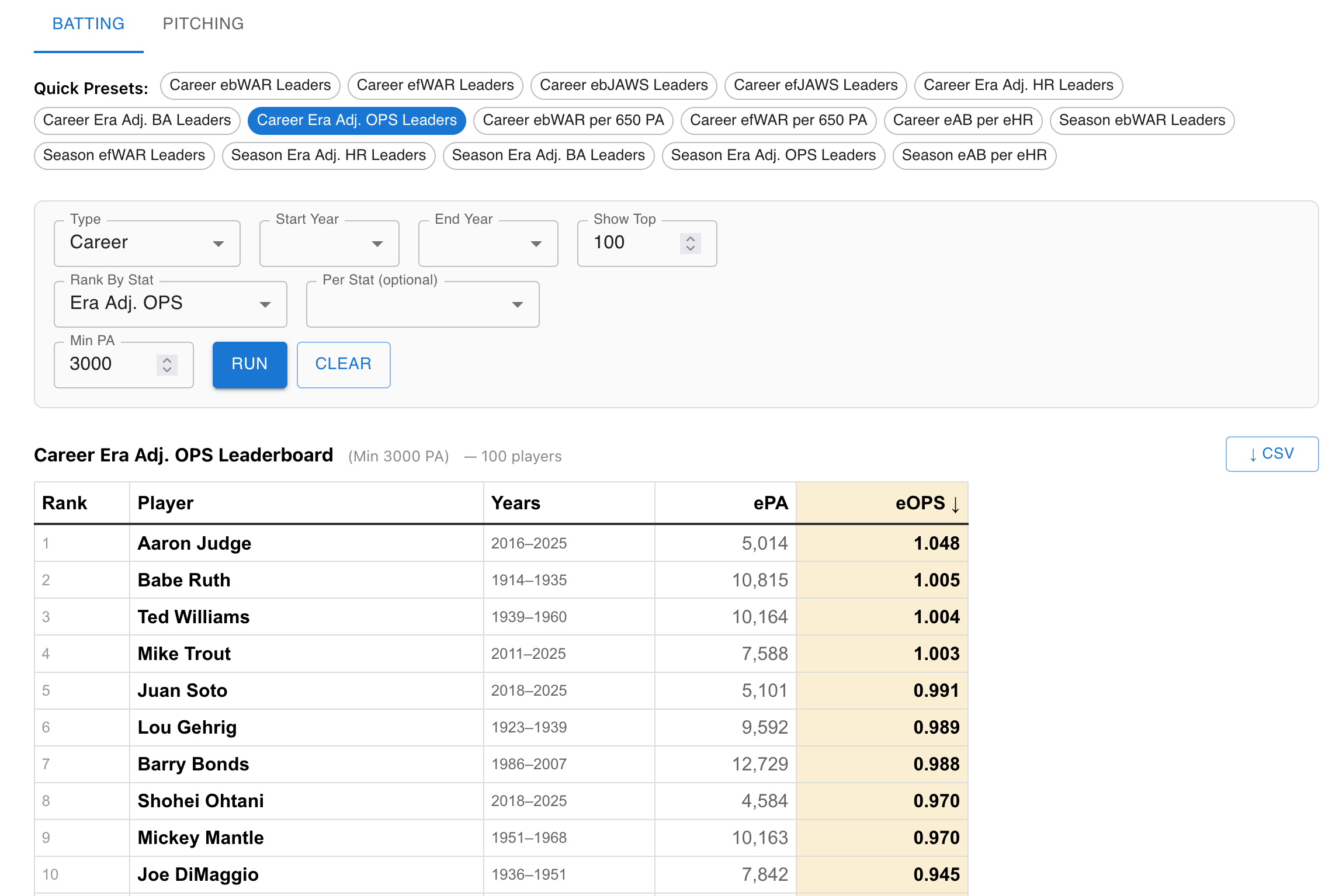
All of our batting statistics are also adjusted for handedness-specific park factors. One nice consequence is that eOPS lives on the familiar OPS scale, but because it adjusts for both park factors and talent pool, it carries interpretive power similar to OPS+ without the 100-baseline convention. You read the number the way you would read any OPS, but the comparison across eras is doing real work.
These additions push era-adjustment beyond WAR and rate stats into the slugging and peak-value territory where player debates and case studies actually live. New interactive leaderboards let you build all sorts of customizable era-adjusted stats, with an option to filter pitchers to relievers only. And you can download any leaderboard as a CSV file for whatever you discover.1 For example:
Career eOPS (default minimum of 3000 PA):
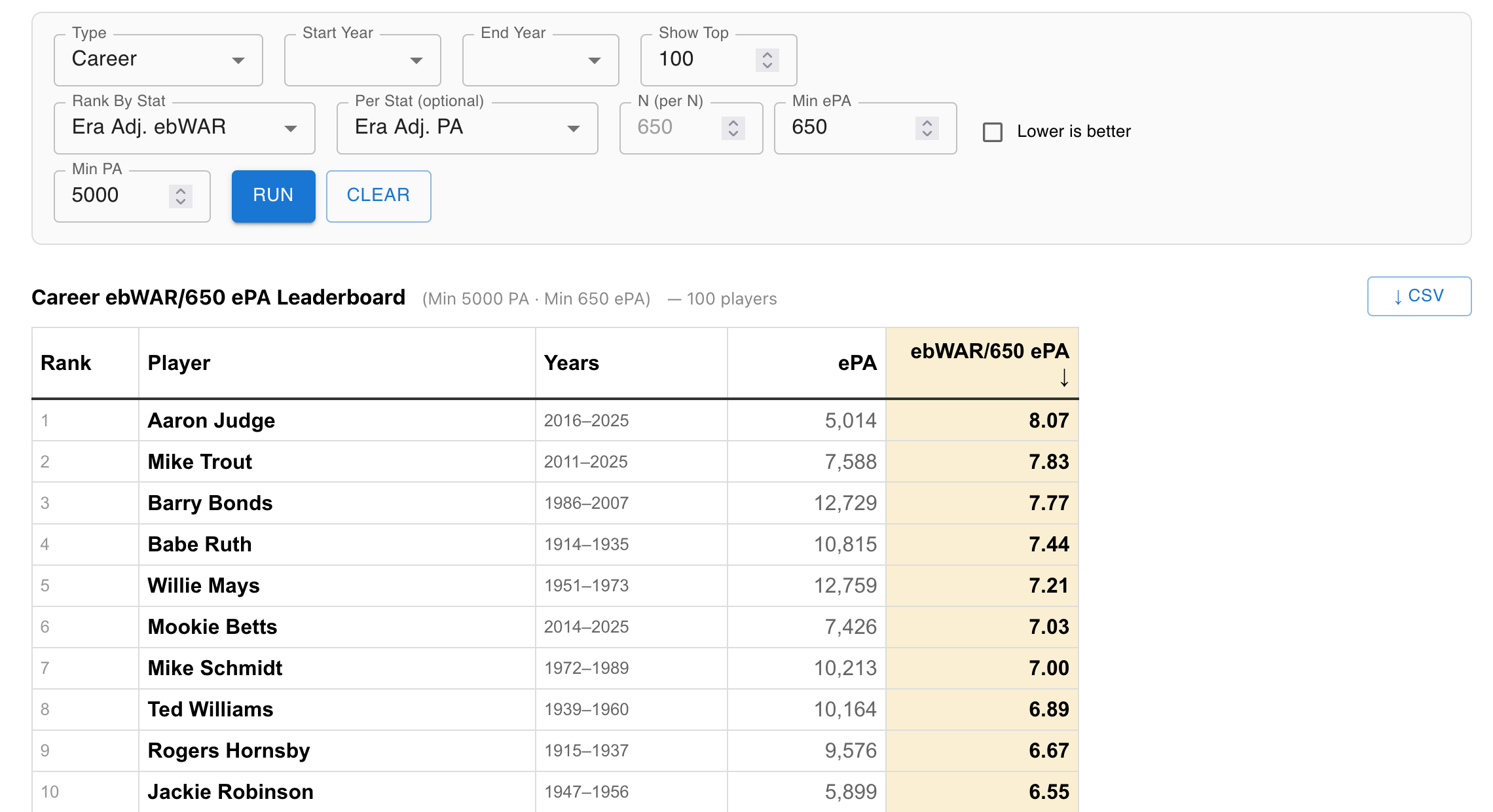
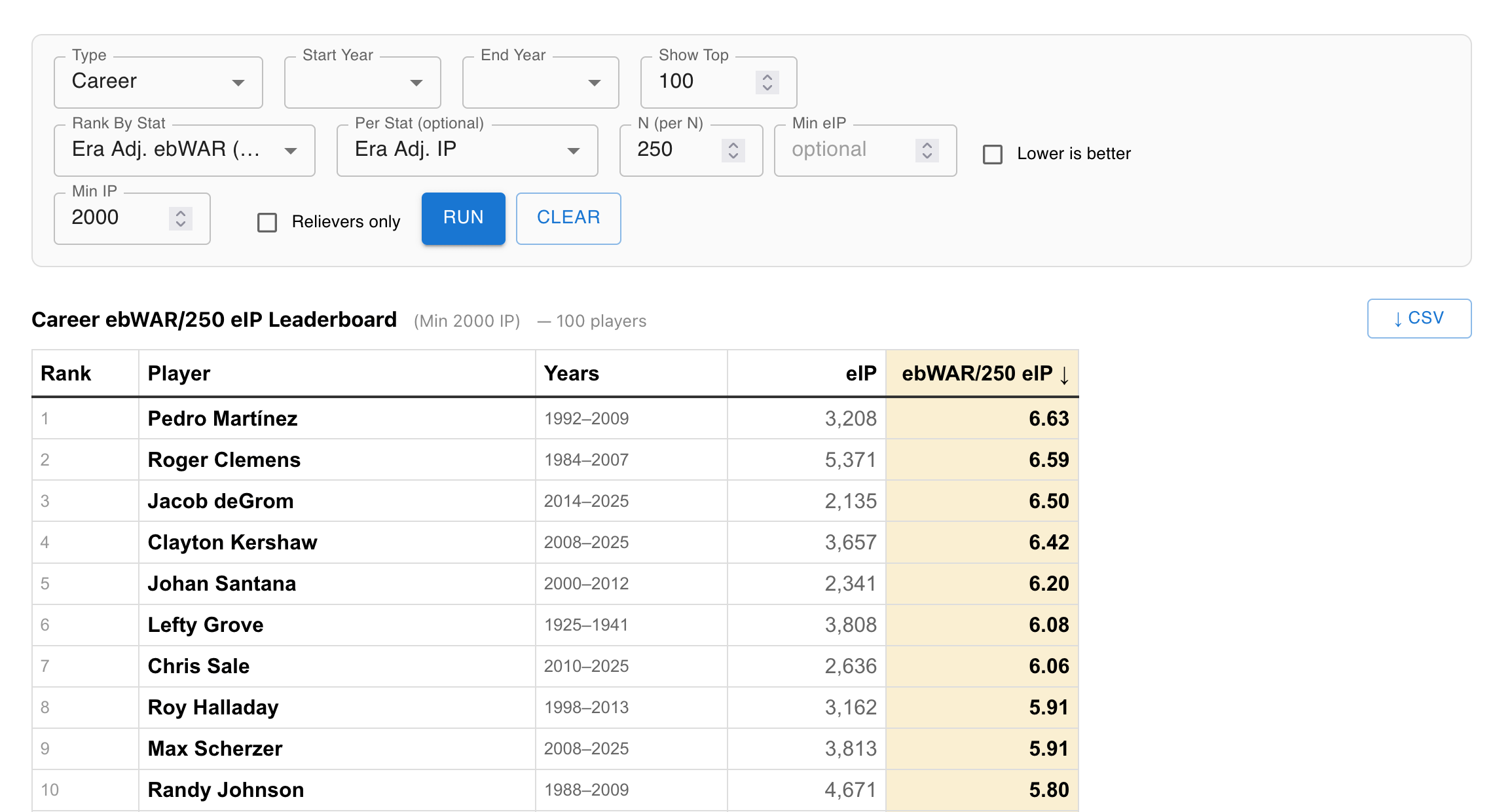
The leaderboards also let you display leaders on an interpretative rate basis. This brings short-career and active players into view alongside longevity legends. Two quick examples:
Career ebWAR per 650 PA (minimum 5000 PA):
Career ebWAR per 250 IP (minimum 2000 IP):
Under the hood
A few changes beyond the new statistics are worth flagging:
Updated talent pool estimate. We have refined the talent pool calculation, shifting the reference group from all eligible males aged 20–29 to eligible white males aged 20–29. Overall, the results do not change much. But, as we will explain below, the adjustment opens a door that was previously closed.
More robust tail modeling in the underlying fullhouse R package, which sharpens estimates at the extremes.
Data through the 2025 season.
A rebuilt site, with a cleaner UI, comprehensive leaderboards with stat downloads, and player-specific linking so you can point directly at any player’s page.
A first look at the Negro Leagues
The new talent pool reference group makes it possible, for the first time in this project, to estimate a talent pool for the Negro Leagues. The old reference group conflated two very different populations into one number; the new one lets us model them separately and compare like with like.
We are not publishing Negro League era-adjusted statistics yet. There is more work to do on the data side, and we want to get it right. But the door is now open, and bringing Negro League greats into the era-adjusted conversation is currently under development.
What’s not changing
The core of the project stays the same. ebWAR, efWAR, and eWAR still mean what they have always meant, and the underlying Full House Model is unchanged. If you have cited era-adjusted WAR in past work, those numbers are still the numbers, just updated with the latest data and refinements.
Where to find everything
All v3.0 stats are live on the project website, and the landing page has been updated to reflect the new additions. For the technical background, the peer-reviewed paper lays out the Full House Model in full, and the GitHub supplement tracks version-to-version changes for anyone who wants the history.
As always, all of our stats are free to use. We will be back to the usual player profiles and zany essays shortly.
Congrats on 3.0, it looks great! The leaderboard tool will be incredibly helpful!
Wonderful news! Thanks for this invaluable resource.